Guangzhou Liangdian Automotive Supplies Co., Ltd.
Guangzhou Liangdian Automotive Supplies Co., Ltd.

Introduction: Foam in a car wash shampoo is a gas-liquid dispersion, and its cleaning behavior comes from surfactant chemistry rather than bubble count alone.
A shopper sees “rich foam” and may read it as a performance promise. A materials learner sees the same phrase and asks a different question: what is foam made of, and how does that structure relate to cleaning? The useful answer sits between those views. Foam is a physical structure created from liquid, gas, and surface-active molecules. Cleaning is a set of chemical and physical processes that happen at interfaces. Understanding the first helps explain the second without turning a product label into a formula sheet.
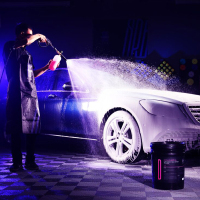
A foam is a colloidal dispersion: gas bubbles are the dispersed phase, and the liquid is the continuous phase. OpenStax’s chemistry chapter on colloids groups foams with emulsions and suspensions because all three contain one substance spread through another. The difference is what is dispersed. In an emulsion, liquid droplets are spread through another liquid. In a suspension, solid particles are spread through a liquid. In foam, gas is spread through liquid. That sounds simple, but it changes how you read a shampoo description. The liquid is the part that carries cleaning chemistry; the bubbles are a structure built when air is mixed into that liquid. Foam bubbles are not empty balloons with cleaner painted on. Each bubble is a thin film of liquid around a pocket of air, and the film has two gas-liquid interfaces. Surfactant molecules gather at those interfaces, with one end favoring water and the other favoring air. This layered arrangement helps the film persist long enough to be visible. The film also drains, thins, and eventually breaks. That is why foam changes over time and why different devices produce different foam textures from the same liquid. A soapy-water demo shows the basic idea: shake a sealed bottle and the liquid turns into bubbles, then wait and the bubbles collapse back into liquid. The cleaning agents were in the liquid before and after; foam is a temporary arrangement, not a separate ingredient. Because foam is a structure, “more foam” is not the same statement as “more cleaning chemistry. ” Bubble count is influenced by how much air is mixed in, how the device works, the concentration used, water hardness, temperature, and how much soil is present. A dense foam can help a shampoo cling to a vertical panel and give a visible working layer, which is useful in a wash process. Yet the cleaning work still depends on surfactant chemistry, contact, soil type, and rinsing. Bubble volume is a visible property; cleaning is a result of several processes acting together. That distinction keeps a foam description in the right category: it describes a physical form, while cleaning performance belongs to the chemistry and the wash method.
General cleaning chemistry starts with interfaces. Water is a polar molecule with strong hydrogen bonding, so it mixes well with other polar materials but not with oily, nonpolar soil. Oil and grease are held together mainly by weaker dispersion forces. A surfactant bridges that mismatch. Its head group interacts with water, and its tail interacts with oil or with air. At a water-oil interface, surfactant molecules arrange themselves so the tail sits toward the oil and the head sits toward the water. At a water-air interface, the same molecular design helps stabilize the liquid film around a bubble. OpenStax’s chapter on intermolecular forces explains why these differences matter: the balance of attractions controls whether molecules prefer to stay together, mix, or sit at an interface.
In general cleaning, a surfactant lowers the resistance between water and a surface, so the water can spread and reach soil instead of sitting in beads. The surfactant tail can associate with oily soil while the head keeps the complex water-compatible. With movement, such as spraying, wiping, or rinsing, the soil is lifted into the wash liquid and carried away. This is why cleaning is not just “water plus bubbles. ” It is water, surfactant, mechanical action, and time working on a soiled surface. A shampoo can be formulated for different foam feel, rinse behavior, or soil suspension, but the underlying job is the same: help the wash liquid contact soil and hold it long enough to remove it. The exact surfactant blend and dosage are formula choices, and those choices are where a named product becomes specific.
When surfactant concentration rises, molecules can cluster into micelles, with tails gathered inside and heads facing the water. Micelles give oily material a place to associate in a water-based system. An emulsion is a related structure: tiny oil droplets are dispersed in water and kept apart by a surfactant film. Both ideas help explain why a cleaning liquid can carry oily soil away instead of letting it settle back onto the surface. They are general models, not a breakdown of one bottle’s ingredients. A formulator may use one surfactant or a blend, and the blend can change foaming, rinsing, and soil handling. The chemistry explains the category; the formula explains the product.
There is a real difference between saying “this shampoo foams” and saying “this shampoo contains a specific surfactant at a specific percentage. ” The first is a product description. The second is formulation information. A foam description can tell you what the product is designed to look or feel like during use, and it can help you compare how one product is presented against another. It cannot tell you the surfactant type, the pH, the active content, or whether the foam was measured in a test. Those details live in a formula sheet or technical document. SURAINBOW’s Touchless Magic Foam Wash is a useful example of that line. The public description identifies it as an automotive foam car wash shampoo and mentions rich foam and higher suspension for Foam Cannons, with rich foam also described for a Hand Pressure foam sprayer. Those phrases tell a reader what kind of product it is and what foam behavior the description emphasizes. Ingredient-level detail is a separate layer. Surfactant types, pH, active content, and test data belong to formulation documentation. That is why general colloid chemistry and intermolecular forces can explain foam and cleaning in principle without confirming a particular shampoo’s formula or cleaning result. The same separation applies to environmental assessment. The US EPA’s Safer Choice criteria for surfactants look at factors such as aquatic toxicity and biodegradation when evaluating surfactant ingredients. That is a product-level assessment process, and a product carries the label only when it has been evaluated for it. The word “surfactant” describes a broad class of molecules; it is not a certification. A car wash shampoo supplier or touchless car wash shampoo manufacturer may use foam language in product communication, but a reader should still keep three things apart: the foam structure, the general cleaning chemistry, and the product-specific documentation.
Foam is easier to understand once you stop treating it as a cleaning ingredient. It is a gas-liquid colloidal dispersion, a temporary structure of bubbles stabilized by surfactant films. The cleaning work comes from surfactant molecules at interfaces, from the way they help water contact oily soil, and from micelles or emulsions that can hold soil in the wash liquid. A product description such as “rich foam” belongs to a different layer. It describes a presented foam behavior, not the formula behind it. Readers who want to go further can compare the general chemistry with the SURAINBOW Touchless Magic Foam Wash product description and note which details are foam language and which would require formulation documentation.
A: The liquid is the continuous phase that carries water, surfactants, and other dissolved or dispersed materials. Foam is what forms when air is mixed into that liquid and surfactant films stabilize the bubbles. The same liquid can produce different amounts of foam depending on agitation and the device used.
A: Not automatically. More bubbles mean more gas has been dispersed and more liquid film is present, but cleaning depends on surfactant chemistry, soil type, contact time, mechanical action, and rinsing. Foam can help a product cling and stay visible on a panel, yet bubble count alone is a poor performance score.
A: No. Surfactants are a class of molecules that help water and oil interact. A certification is a product-level assessment against defined criteria. For example, EPA’s Safer Choice criteria evaluate surfactant ingredients for factors such as aquatic toxicity and biodegradation, but a product still needs its own evaluation to carry that label.
11.5 Colloids - Chemistry 2e | OpenStax
10.1 Intermolecular Forces - Chemistry 2e | OpenStax
Safer Choice Criteria for Surfactants | US EPA