Product Overview
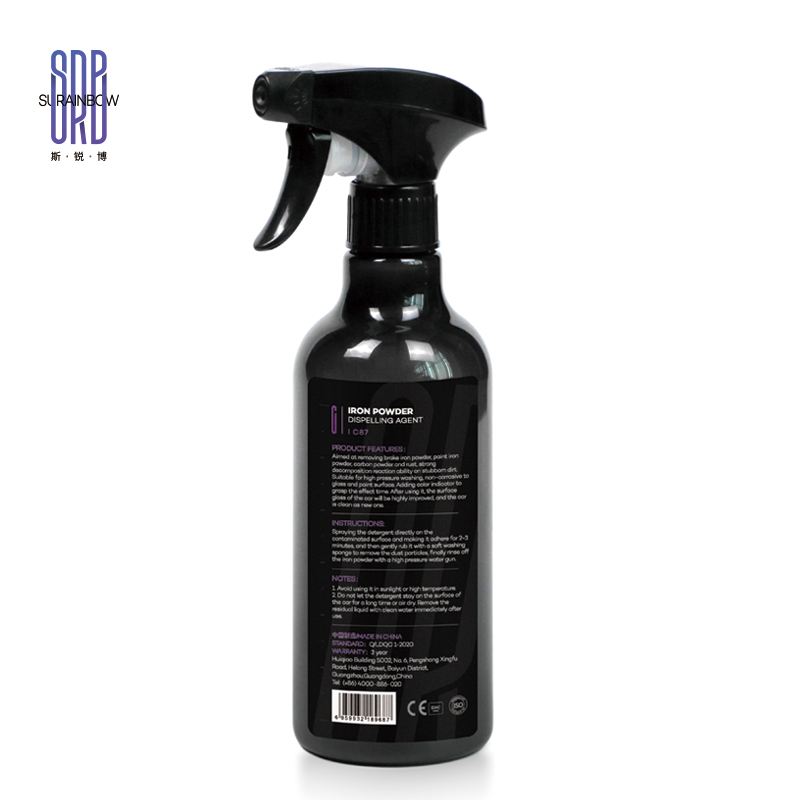
Iron fallout is what makes a freshly washed panel feel rough even after the shampoo has done its work. C87 Iron Fallout Remover from the SURAINBOW car care products range is the liquid that deals with it — a concentrate diluted with water, sprayed onto the panel, and left to break embedded particles down before the surface is rinsed and refined. The reaction is deliberately strong on contamination that has cured onto the paint over months rather than days.
It earns its place on a daily driver carrying brake dust in the lower doors and around the rear bumper, on an imported or long-stored car that arrived with industrial fallout baked into the clear coat, and on any car booked for ceramic car care or a polish, where the surface has to be genuinely bare before anything is applied.
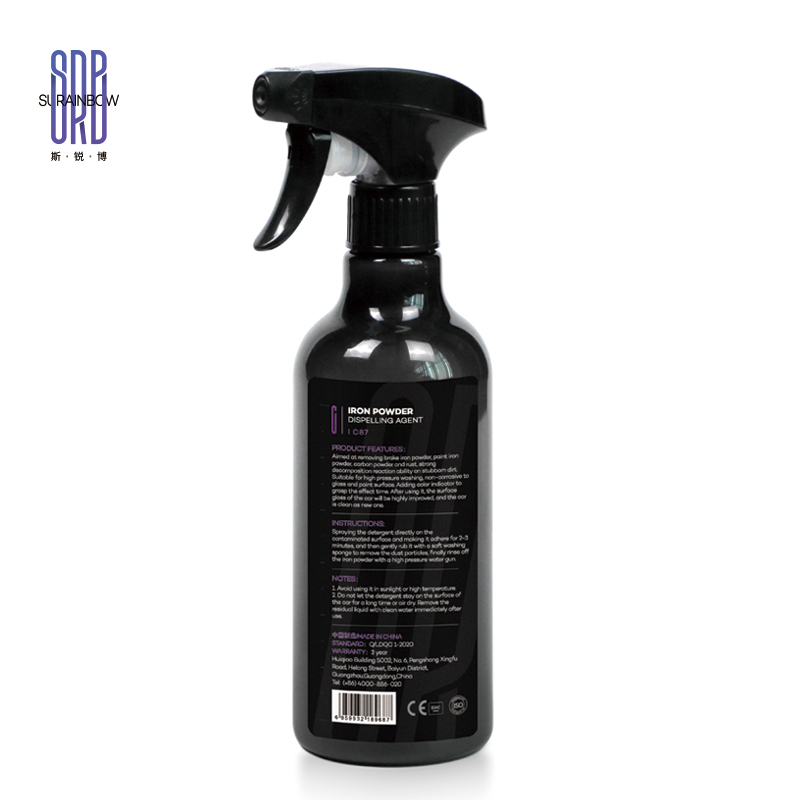
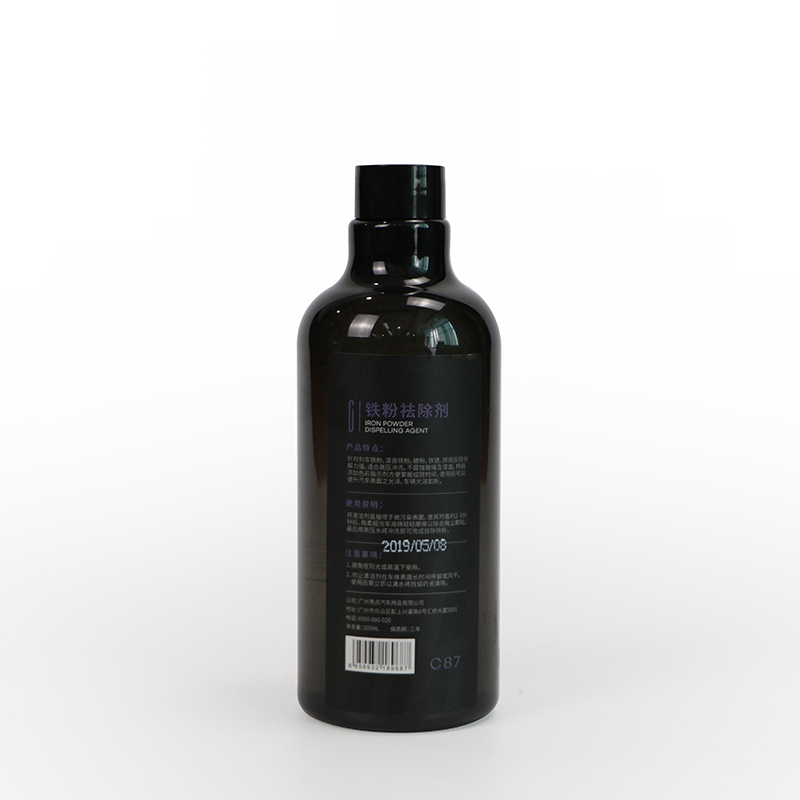
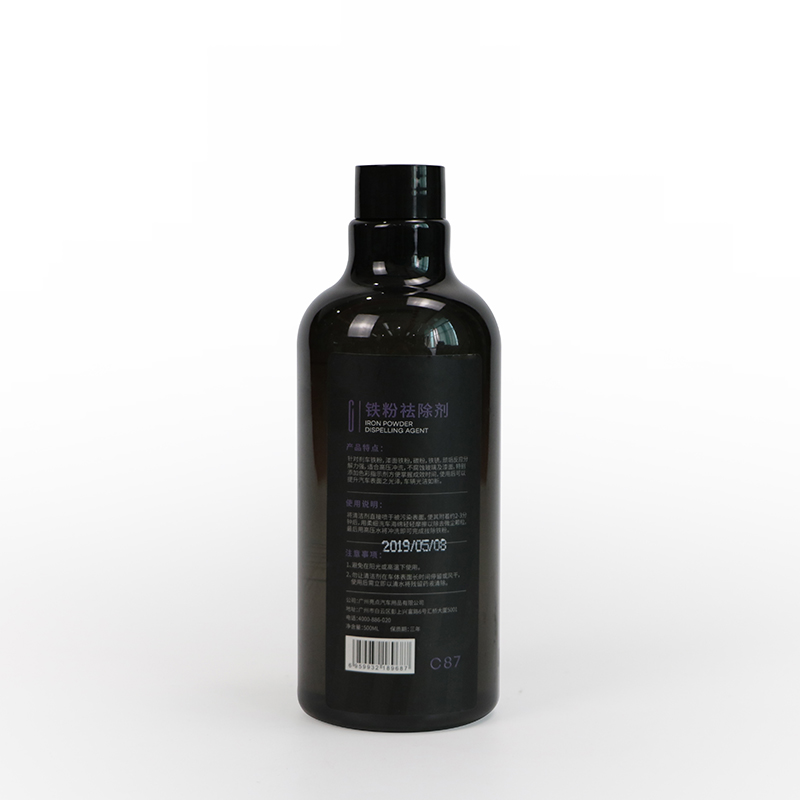
Professional car care products are judged on the decontamination stage because everything downstream depends on it — a pad, a disc or a coating laid over iron will not deliver the finish the customer was promised. The working pack is a black bottle with a trigger sprayer, so one mix can travel around the car instead of sending the technician back to a drum.
What It Removes
- Brake iron powder — the black speckling that builds up on lower doors, sills and the rear bumper behind the wheels. A car detailing cleaner that works chemically attacks the particle itself, so it rinses away instead of being dragged across the clear coat by a mitt.
- Paint iron powder — airborne fallout that settles on the bonnet, roof and boot lid and feels like grit through a plastic bag. Left alone it blooms into rust pinheads; the remover gets to it before that happens.
- Carbon powder — exhaust soot and carbon deposits around tailpipes and lower rear panels, where an ordinary wash only reaches the surface film.
- Rust and rust staining — surface rust and the brown tears that run down from badges, trim clips and stone chips. Clearing them first keeps rust particles out of the polishing pad.
- Stubborn bonded dirt — the decomposition reaction is built for contamination that cured into the panel months ago and no longer responds to a normal wash pass.
- Badges, trim and panel gaps — where a mitt never reaches and contamination collects first. A soft brush works the liquid into the gap and the rinse carries it out, with no extra scrubbing and no additional automotive care products.
Dilution & Spray Application
- Dilute 1:3. One part concentrate to three parts clean water. Mix only what the job needs; a fresh mix behaves more predictably than one left standing in a bottle, and the ratio is what makes the cost per car predictable.
- Fill an acid-alkali resistant spray pot. The chemistry will attack an ordinary sprayer over time, so use a chemical-resistant bottle and mark it clearly as iron remover so it is never picked up for shampoo by mistake.
- Spray the contaminated surface. Work panel by panel, starting low and moving up the car, and keep the coat even. Lower doors, sills, the rear bumper and the area behind the wheels usually take the heaviest application.
- Let it adhere for two to three minutes. Watch the colour indicator rather than the clock, and do not let the film dry on the panel.
- Rinse with high pressure water. The product is suited to high pressure washing. Rinse from the top down and flush the panel gaps, badges and arch lips; that rinse is what separates a decontamination pass from a plain car wash cleaner, because the dissolved iron has to leave the panel, not just change colour on it.
- Rub gently with a sponge. Any remaining dust particles lift away with light hand pressure. There is no need to scrub at the surface, and scrubbing is what puts marks into a finish that was previously sound.
- Finish with a pneumatic clay grinding disc and a waxing machine. The disc takes off what the chemical loosened, and the machine step refines the paint so the panel is ready for polishing or coating.
- The formula carries a colour indicator, and that single detail changes how the product is used. Instead of working to a stopwatch, the technician watches the liquid change colour on the panel: the shift means the active chemistry is meeting iron and consuming it. The instruction is to let it adhere for two to three minutes, but the colour is the better signal. A heavily contaminated daily driver develops the change quickly and across the whole lower panel; a well-kept car may only show it in patches around the arches and the boot lid. Two habits keep the reaction under control. Work on cool panels and out of direct sun, because a hot bonnet flashes the liquid dry, and a dry film stops reacting and leaves residue behind. Work one section at a time so nothing sits while you attend to another panel. Once the colour has developed, rinse — leaving it longer does not remove more iron, and it risks the film drying in place. This is not a car wash cleaner and it does no cleaning of general road film; that work belongs to the wash stage before it.
Where It Fits in the Detail
- After the wash, never before. The panel has to be washed and rinsed first. Fallout remover applied to a dirty car spends its reaction on road film instead of on the iron you are trying to reach.
- Before the clay disc. The chemical loosens what is bonded into the clear coat, and the pneumatic clay grinding disc then lifts the loosened material away with the rest of the surface contamination. Claying first simply clogs the disc with iron particles.
- Before the polisher. Every pass of a waxing machine over embedded iron drags abrasive particles across the paint. Taking the iron off first is what allows a polish to finish down cleanly instead of chasing marks around the panel.
- Before ceramic car care. A coating only performs on a bare surface. Lay it over fallout and the particles sit trapped underneath, where the finish starts to fail from below rather than from the weather.
- As a standing step, not a rescue. Once a car has been decontaminated, a repeat pass at each polish or coating job keeps the paint smooth. Cars parked near rail lines, building sites or industrial estates need it more often than a garage-kept car.
- One mix for the whole car. The same working solution covers the lower body and the glass, so a technician is not switching between several car care products mid-job.
Surface Safety & Handling
The formula is stated as non-corrosive to glass and paint — the line car cleaning chemical manufacturers put on the label because it decides where the product can be used. It means the same spray covers the lower body and the glass, rather than stopping at the sills.
That statement covers intended use at the stated dilution; it is not a licence to spray it on anything at any strength. On a freshly repaired or repainted panel, on bare or anodised metal trim, or on a finish you have not worked with before, test a small hidden area first and check the result before you touch the visible panels.
Handling is the other half. Wear gloves and eye protection, keep the work area ventilated and avoid breathing the mist — normal practice with any reactive decontamination chemical. Never let the film dry on a hot panel or in direct sun, and never let it sit on glass longer than the reaction needs. Between jobs, keep the concentrate sealed and upright, out of direct sunlight, and keep the working bottle labelled so it cannot be mistaken for a shampoo or a car wash cleaner. Rinse thoroughly at the end, panel gaps and arch lips included, because dried residue is the usual cause of a streaked or patchy finish.
Specifications
| Product | Iron fallout remover (iron powder dispelling agent) |
| Product code | C87 |
| Form | Concentrated liquid |
| Dilution | 1:3 with clean water |
| Dwell time | 2-3 minutes |
| Targets | Brake iron powder, paint iron powder, carbon powder, rust |
| Surfaces | Paint and glass |
| Rinse | High pressure washing |
| Application | Acid-alkali resistant spray pot, sponge, pneumatic clay grinding disc, waxing machine |
| Colour indicator | Included |
| Paint and glass compatibility | Stated non-corrosive |
After-Sales & Batch Traceability
Every batch is recorded. Raw-material traceability, inspection records and retained samples are kept, so a question about a specific delivery can be answered against the material that actually went into it. That is the difference between buying from car cleaning chemical manufacturers who fill their own product and buying from a trader who forwards a carton: the batch number on the label leads somewhere. Keep that number with your receiving paperwork.
If something is wrong, a complete report gets a faster answer than a description. Send the order or sample reference, the batch number, the affected quantity, clear photos or video, and a note on how the product was stored and used. Packaging, leakage and shortage issues should be reported within 7 days of receipt, and product quality concerns within 30 days, so the batch can be checked against the retained sample while the trail is still fresh.
This matters more with a reactive chemical than with a bottle of shampoo. Car care manufacturers who fill their own material can compare your batch with the one still sitting in the sample store; a business that only trades cannot. If a delivery does not behave like the sample you approved, that comparison is the first thing we run.
Samples, Testing & Packaging Approval
- Send the brief. Product, target market, sales channel, expected quantity, pack size and label language. The more of this arrives with the first message, the closer the sample is to what you actually intend to sell.
- Test the sample on your own surfaces. A sample is dispatched so your team can mix at 1:3, watch the colour change and judge dwell time against the contamination you see in your market. Sample scope and any applicable charges are confirmed before dispatch.
- Record the evaluation. Note the dilution, the dwell time, the panel temperature and the result you accept, so the approved sample means the same thing to both sides later.
- Seal the approved sample as the bulk reference. Once it is signed off, the sealed sample is what car care manufacturers compare every later batch against. It is stored and identified, and the specification, test criteria and tolerances are written into the order confirmation.
- Approve packaging and artwork. Primary container, closure, label, carton and shipping marks are proofed before production. Supply artwork files, label content, barcode data and pack specifications for review, and check the label language against the market you are selling into.
- Release bulk production. Professional car care products move through these same steps, so the bottle that arrives in the container is the one that was approved on the bench — not a version of it.
Ordering & Delivery
- Stock and dispatch. In stock and fast shipping on the lines we hold in Guangzhou.
- Minimum order quantity. Confirmed at quotation. It depends on pack size, label and carton rather than on the liquid alone, so state the pack you want and the quantity you plan to move.
- Pack size and carton. Confirm bottle size, closure and carton configuration before the order is placed, and ask for carton dimensions and gross weight so your freight forwarder can plan the load.
- Documents at source. The SDS, CoA and GHS label information can be issued against the batch you actually receive — the paperwork car cleaning chemical manufacturers are judged on when a container reaches customs. Tell us the destination market and shipping mode and we will confirm which set your shipment needs.
- Shipping methods. Air and sea freight can be arranged, including LCL consolidation, 20FT, 40GP and 40HQ container loads, and DDP options where the destination allows.
- Payment. Confirm the accepted method, currency and schedule with the commercial offer. The balance is settled before shipment is released, and the document set is handed over with the dispatch confirmation.
- Consolidation. Automotive care products, polishing pads and detailing tools can travel together, so a container carries a complete range instead of a single line.
Scale & Supply Capability
SURAINBOW is run by Guangzhou Liangdian Automotive Supplies Co., Ltd., a factory-trade operation set up in Guangzhou in 2010 and now 50 people strong. Sixteen years in car care have given us a one-stop supply position: our own SURAINBOW lines are held in stock for fast shipping, and an associate factory with modern production equipment and an established quality management system keeps replenishment moving. We take OEM and ODM work and our R&D team develops to your specification. Buyers in the Middle East, the United States, Southeast Asia, Europe, the UK, Russia, Africa and Australia already order from us.
FAQ
Does this replace claying?
No, and it is not meant to. Iron fallout remover works chemically on the particles bonded into the clear coat; the pneumatic clay grinding disc then lifts the loosened material and the rest of the surface contamination away, and the waxing machine refines what is left. Claying first would drag iron particles across the paint and clog the disc. The two steps do different jobs, which is why a car detailing cleaner of this type is always followed by mechanical decontamination rather than used instead of it.
Why does the liquid change colour, and what should I watch for?
The colour indicator reacts with iron as the product works, so the change is a live read on how much contamination is being consumed. Watch for the colour to develop across the panel, then rinse. Do not read it as a reason to leave the product on longer: once the reaction has run, extra time only risks the film drying. It also shows you something a car wash cleaner cannot — where the contamination actually is, which is usually heaviest on the lower doors, the rear bumper and around the arches.
Can it be used on glass as well as paint?
Yes. Windscreens, side glass and the rear screen can be treated with the same mix as the panels. Rinse glass thoroughly, keep the liquid off rubber seals for longer than the reaction needs, and test a corner first on a screen that already carries a water-repellent coating. It is one of the more practical car care products to keep on the shelf for exactly this reason: the lower body, the glass and the details all come from one bottle.
What dilution should I mix, and can I go stronger on a badly contaminated car?
Mix at 1:3 — one part concentrate to three parts water — and keep to it. Going richer does not remove more iron; it costs more per car and leaves a heavier film that is harder to rinse before it dries. If a car is heavily contaminated, work in smaller sections and give the full two to three minutes rather than changing the ratio. Professional car care products are usually dosed by the job, so mix what you will use in one pass.
How often does a car need an iron removal step?
There is no fixed interval; it depends on where the car lives and how it is parked. Judge it by feel — run your fingertips over a clean, dry lower door or rear bumper, and if it feels like sandpaper through a thin plastic bag there is bonded iron to remove. Cars near rail lines, building sites or industrial estates need it more often than a garage-kept car, and anything going into a polish or ceramic car care gets the step regardless of the calendar.
Is it safe on a freshly repaired or repainted panel?
Treat a fresh repair as its own case. Even at the stated dilution, a new clear coat continues to cure and behaves differently from a factory finish. Test a small hidden area — inside a door shut or behind a number plate — confirm with the paint shop that the panel is cured, and only then work the visible surface. It is the same caution car care manufacturers give for any reactive chemical on new paint.